Single Video vs Playlist Length: What to Calculate
Learn when a video's displayed runtime is enough, when to total a YouTube playlist, and how to plan remaining watch time
Calculator BasicsRead guide
Turn a six-hour lecture into realistic study sessions using playback speed, topic boundaries, breaks, recall, and a worked schedule.
A six-hour lecture is not a useful calendar item. It is too long to fit a normal study session, and its listed runtime says nothing about pauses, practice or revision. The better approach is to divide the material into blocks with a specific topic, a realistic playback speed, and time to test what you remember. This guide shows how to do that with a concrete six-hour example.
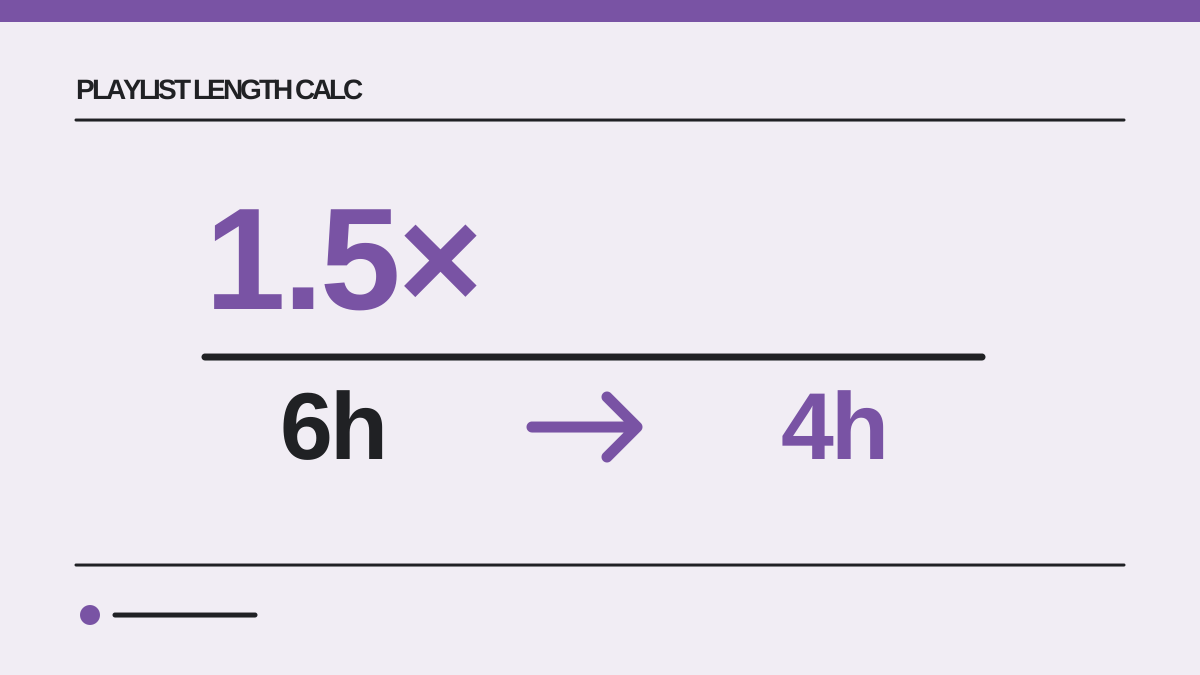
The first distinction is between source duration and study duration. The source may contain six hours of video. At 1.5x, the uninterrupted player clock is four hours. Your study time will be longer because learning requires stopping, thinking, writing and sometimes replaying. A plan that reserves only four hours is a playback plan, not necessarily a learning plan.
Write down when you can actually study. “Two hours every evening” may sound generous, but if setup, breaks and notes consume 25 minutes, you have about 95 minutes of playback or exercises. Decide whether your two hours are an absolute stopping time or a rough target. If you need a fixed ending time, leave a buffer instead of filling every minute.
Then inspect the lecture structure. Look for chapters, topic changes, slides, exercises, or breaks introduced by the speaker. If the six-hour lecture is a playlist, its video boundaries are natural candidates. If it is one recording, the chapter timestamps or slide titles can serve the same purpose. Avoid cutting a proof, coding demonstration or problem explanation halfway through merely to make every block the same length.
Divide the normal duration by the chosen speed. For six hours at 1.5x, 360 minutes ÷ 1.5 = 240 minutes, or four hours. At 1.25x it is 288 minutes, or four hours 48 minutes. At 2x it is 180 minutes, or three hours. Those are exact playback estimates for a constant speed before you add any pauses.
| Normal lecture length | Speed | Pure playback | With four 10-minute breaks | With four 20-minute review blocks |
|---|---|---|---|---|
| 6 hours | 1x | 6h 00m | 6h 40m | 7h 20m |
| 6 hours | 1.25x | 4h 48m | 5h 28m | 6h 08m |
| 6 hours | 1.5x | 4h 00m | 4h 40m | 5h 20m |
| 6 hours | 2x | 3h 00m | 3h 40m | 4h 20m |
The last two columns are separate scenarios. If you need both breaks and reviews, add both allowances. For example, four hours of playback at 1.5x plus 40 minutes of breaks plus 80 minutes of review becomes six hours of total scheduled time. Your own pace can differ, so use the table to budget rather than to promise completion.
Imagine the lecture has four topic sections of 90 minutes each at normal speed. At 1.5x, each section takes one hour to play. Reserve ten minutes after each section for a break and 20 minutes to summarize the topic or solve a question. Each block occupies 90 minutes of your calendar. Four blocks therefore take six hours of study time across however many days you choose.
| Block | Topic source time | Playback at 1.5x | Break | Recall or practice | Total scheduled time |
|---|---|---|---|---|---|
| 1 | 90m | 60m | 10m | 20m | 90m |
| 2 | 90m | 60m | 10m | 20m | 90m |
| 3 | 90m | 60m | 10m | 20m | 90m |
| 4 | 90m | 60m | 10m | 20m | 90m |
Two blocks fit into a three-hour morning. If you have only two-hour evenings, schedule one block per evening and use the remaining half hour to revisit difficult notes, prepare for the next topic, or simply stop on time. This four-day plan is often more dependable than trying to push the entire lecture into one evening at 2x.
Real lectures rarely divide into four equal sections. Suppose the first topic is 45 minutes, the second is 120, the third is 75, and the last two total 120 minutes. A good block boundary can combine the first two topics if they form one argument, or split the 120-minute topic at a natural exercise. The arithmetic supports the plan, but the meaning of each topic chooses the boundaries.
The same lecture may include a slow introduction, a dense explanation and a hands-on exercise. You do not have to watch all of it at one speed. Try a short sample of each type. If you can explain the content immediately afterward, the speed may be workable. If you are repeatedly rewinding, the nominal speed is misleading: your effective study speed is lower.
For example, watch a 60-minute introduction at 1.75x, a two-hour conceptual section at 1.25x, a two-hour practical exercise at 1x, and a 60-minute recap at 1.5x. The playback estimate is about 34 minutes 17 seconds + 96 minutes + 120 minutes + 40 minutes, or 4 hours 50 minutes 17 seconds. Add practice and breaks separately. This is longer than the simple six-hour ÷ 1.5 calculation, but it reflects how you intend to use the material.
If you must choose one speed for planning, start with 1.25x for unfamiliar material and adjust only after the first block. A quick speed that forces you to rewatch half the lesson usually fails to save time. A slower speed that allows active recall may be more efficient overall.
A good stopping point lets you resume without rewatching an earlier explanation. At the end of a block, write one sentence stating the main idea, one question you can answer without the video, and one point you still do not understand. Record the timestamp or video number where you stopped. These tiny notes make the next session easier to start.
If the recording has no chapters, create your own rough outline while scanning it. You do not need to understand the entire lecture in advance. List the opening title, visible slide headings, exercise start points and conclusion. Then assign a block to each coherent section. If a section is much longer than your available time, split it at a pause, example, or transition that the speaker makes naturally.
For a playlist, count the full runtime first. The YouTube Playlist Length Calculator can show the total and speed-adjusted estimates. If you have already watched some videos, calculate only the remaining range rather than planning from the beginning. That avoids overstating the work you still need to do.
A break helps attention, but a recall step tells you whether the material stayed with you. After a block, close the player and write a short explanation from memory. For a worked problem, try the first step yourself before looking at the speaker's solution. For a coding lecture, recreate one small change without copying every keystroke. This makes a block more valuable than uninterrupted viewing.
Keep the recall task small enough to finish. A 15-minute summary is better than an ambitious review plan you never start. If you discover a gap, mark the exact timestamp to revisit. Do not repeatedly restart the whole lecture. The goal is to use replay precisely where it changes understanding.
Work backward from the deadline. If you have five hours and the lecture is six hours long, 1.25x gives four hours 48 minutes of pure playback and almost no margin. At 1.5x, pure playback is four hours and you have one hour for breaks. If the topic is very difficult, even that may be optimistic. Decide which sections require full attention and which can be previewed, then acknowledge that watching everything is different from mastering everything.
Do not hide an impossible schedule behind a higher speed. If you pause a two-hour technical section every few minutes, its real duration can exceed the original runtime. Prioritize the chapters that matter for the assignment or exam, and schedule the remaining material later. A realistic partial plan is more useful than an exact-looking total that leaves no room for learning.
The player runs for four hours if you watch continuously at 1.5x. A study plan should add breaks, notes and practice, so the full calendar time will usually be longer.
Four blocks of 90 minutes of source material work as a starting point. At 1.5x, each block plays for one hour, leaving time for review. Adjust boundaries to match actual topics.
No. A coherent topic and a clear stopping point matter more than equal duration. A difficult section may need a shorter block with more practice.
Yes. Calculate each segment using its own speed, then add the actual times. This is more accurate than applying one average speed to everything.
Record the next starting timestamp, one main idea, one question you can answer from memory, and any point to revisit. These notes reduce the cost of resuming later.
To measure the duration of a real video playlist before dividing it into blocks, use the YouTube Playlist Length Calculator.
 Playlist Length Calc
Learn when a video's displayed runtime is enough, when to total a YouTube playlist, and how to plan remaining watch time
Find the real playback time for a video, lecture, or playlist at 1.25x, 1.5x, 1.75x, or 2x, with a conversion chart and
Estimate the views and average view duration needed for 4,000 qualified YouTube watch hours, with examples and eligibili