How to Split a Long Lecture into Study Blocks
Turn a six-hour lecture into realistic study sessions using playback speed, topic boundaries, breaks, recall, and a work
Playback SpeedRead guide
Find the real playback time for a video, lecture, or playlist at 1.25x, 1.5x, 1.75x, or 2x, with a conversion chart and planning examples.
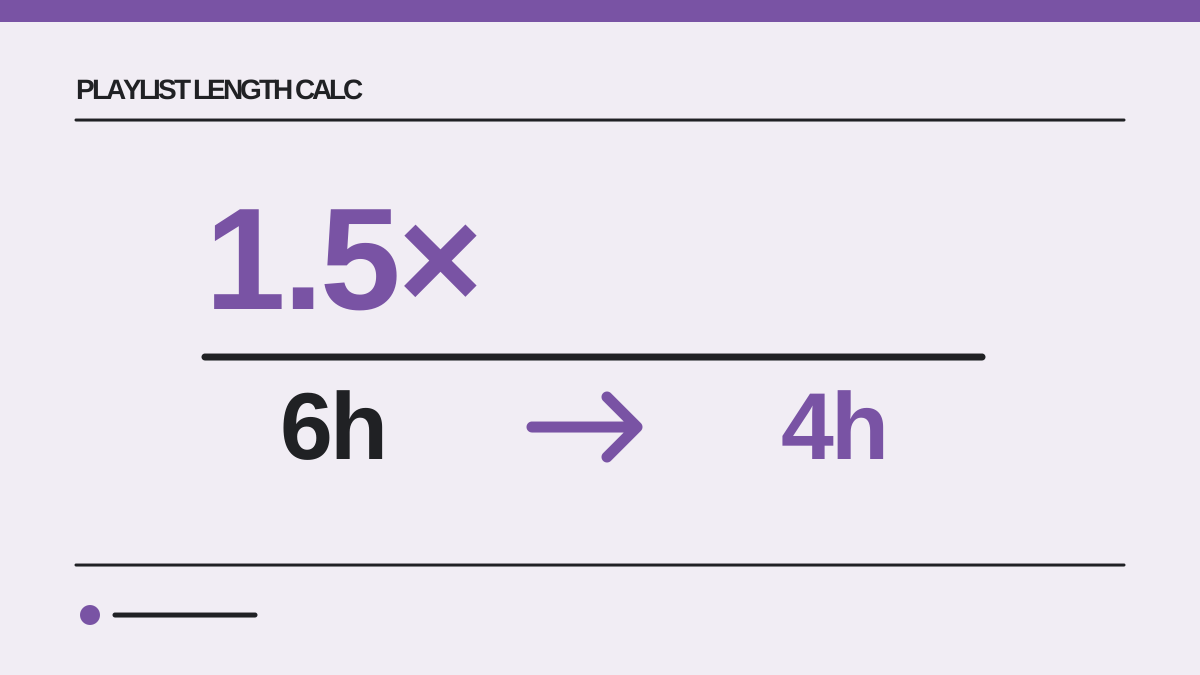
A playback speed chart answers a simple question: if a video has a stated duration, how long will you actually spend watching it? Divide the normal duration by the speed. A six-hour lecture becomes four hours at 1.5x, while an eight-hour course becomes six hours and 24 minutes at 1.25x. The chart below shows common lengths so you can plan without doing the division each time.
The numbers describe uninterrupted playback. They do not include note-taking, pauses, buffering, exercises, or the time spent finding the next video. If you are planning a study session, treat the chart as a starting point and add your own buffer.
| Normal duration | 1x | 1.25x | 1.5x | 1.75x | 2x |
|---|---|---|---|---|---|
| 30 minutes | 30m | 24m | 20m | 17m 9s | 15m |
| 1 hour | 1h | 48m | 40m | 34m 17s | 30m |
| 2 hours | 2h | 1h 36m | 1h 20m | 1h 8m 34s | 1h |
| 3 hours | 3h | 2h 24m | 2h | 1h 42m 51s | 1h 30m |
| 4 hours | 4h | 3h 12m | 2h 40m | 2h 17m 9s | 2h |
| 5 hours | 5h | 4h | 3h 20m | 2h 51m 26s | 2h 30m |
| 6 hours | 6h | 4h 48m | 4h | 3h 25m 43s | 3h |
| 8 hours | 8h | 6h 24m | 5h 20m | 4h 34m 17s | 4h |
| 9 hours | 9h | 7h 12m | 6h | 5h 8m 34s | 4h 30m |
| 10 hours | 10h | 8h | 6h 40m | 5h 42m 51s | 5h |
| 12 hours | 12h | 9h 36m | 8h | 6h 51m 26s | 6h |
Values that include seconds are rounded to the nearest second. For a long playlist, several rounded rows should not be added together as though they were exact. Add the original durations first, divide once, and then round the final answer.
The formula is actual playback time = normal duration ÷ playback speed. Use one unit for the calculation. For instance, a two-hour video contains 120 minutes. At 1.5x, 120 ÷ 1.5 = 80 minutes, or one hour and 20 minutes. At 1.25x, 120 ÷ 1.25 = 96 minutes, or one hour and 36 minutes.
For a duration written as hours and minutes, convert it to minutes first. A lecture listed as 2 hours 45 minutes is 165 minutes. At 1.5x, 165 ÷ 1.5 = 110 minutes, or one hour and 50 minutes. If a video is listed as 1:37:30, convert everything to seconds for an exact answer: 5,850 seconds ÷ 1.25 = 4,680 seconds, which is 1:18:00.
This operation works for a single video and a playlist. The only difference is how you obtain the normal duration. For a single video, the player shows it. For a playlist, add the durations of all available videos first. The playlist length calculator can collect that total from a playlist URL and display adjusted times. A chart is most useful when you already know the original length.
Speed is a multiplier, but the percentage of time saved is not the same number as the speed increase. At 1.25x, you use 80% of the normal time and save 20%. At 1.5x, you use two-thirds and save one-third. At 1.75x, you use about 57.1% and save about 42.9%. At 2x, you use half and save half.
That distinction matters when comparing options. Increasing from 1x to 1.5x saves two hours on a six-hour lecture. Increasing again from 1.5x to 2x saves one additional hour. The second speed jump may make the lecture harder to follow, so the extra hour saved on paper may disappear into rewinds.
Suppose a recorded lecture lasts six hours and you have two evenings with two and a half hours each. At normal speed, five hours is not enough. At 1.25x, the lecture takes four hours and 48 minutes; that leaves only 12 minutes across both evenings for breaks or notes. At 1.5x, the playback itself takes four hours, leaving one hour for pauses and review. That is 30 minutes of buffer each evening.
You could split the lecture at its topic boundaries, rather than stopping exactly after two hours of wall-clock time. If the first unit is 2 hours 15 minutes at normal speed, it takes 1 hour 30 minutes at 1.5x. Add a 15-minute break, then cover another shorter unit. On the second evening, finish the remaining units and revisit a difficult segment at normal speed.
This is also why the phrase “six hours in 1.5x speed” has two possible answers. The mathematical answer is four hours. A realistic study plan may need four and a half or five hours after notes, pauses, and practice. Keep those numbers separate.
An eight-hour course becomes 6 hours 24 minutes at 1.25x. If you have three days, that is 2 hours 8 minutes of playback per day. Add a 20-minute review block after each day and the schedule becomes about 2 hours 28 minutes per day. If each day has only two hours available, the course will not fit in three days even though the accelerated playback sounds close.
At 1.5x, the same course takes 5 hours 20 minutes. Spread over three days, the playback share is roughly 1 hour 47 minutes per day. This leaves more room to practice, but only if the course remains understandable at that speed. Try the first lesson at 1.25x before committing the entire schedule to 1.5x.
Speech-led material often tolerates a moderate increase. Familiar lectures, slow demonstrations, interviews and review sessions can be good candidates. Dense proofs, language pronunciation, music instruction, coding along and videos with rapidly changing diagrams need more attention. A speed you can sustain matters more than the fastest setting in the player.
A useful test is to watch ten minutes at the proposed speed, then explain the main idea without replaying it. If you cannot do that, reduce the speed. If you repeatedly pause for the same kind of detail, factor those pauses into your plan or choose a slower setting for those chapters. A chart estimates the player clock; it cannot measure comprehension.
Many courses include different kinds of segments. You might watch a familiar introduction at 1.75x, an unfamiliar example at 1.25x, and a hands-on exercise at 1x. In that case, one speed for the whole course is only a rough estimate. Divide the source into sections, calculate each section separately, and add the results.
Imagine a three-part playlist: a one-hour overview at 2x, a two-hour lesson at 1.5x, and a 90-minute exercise at 1x. The overview takes 30 minutes. The lesson takes 80 minutes. The exercise takes 90 minutes. Together, that is 200 minutes, or 3 hours 20 minutes. Simply dividing the full 4 hours 30 minutes by one speed would be wrong because no single speed applies to every section.
If you have dozens of videos, choose a planning speed for the playlist and use the calculator for a baseline. Then adjust sections you know will require normal playback. For example, a 12-hour playlist at 1.5x has eight hours of pure playback. If two of those original hours are hands-on work watched at 1x, the remaining ten hours take 6 hours 40 minutes at 1.5x; the combined estimate is 8 hours 40 minutes. The difference is large enough to change a weekend plan.
Eight hours divided by 1.5 is 5 hours 20 minutes of uninterrupted playback. Add breaks and note-taking separately.
A six-hour lecture takes four hours at 1.5x. If you need to solve problems or review notes, reserve more than four hours on your calendar.
No. The player runs 50% faster, but the time needed falls by one-third. A 90-minute video takes 60 minutes, saving 30 minutes.
For an accurate total, add original durations, divide by speed, and round once. Rounding individual videos can accumulate a noticeable difference across a long playlist.
No. It estimates how long a viewer spends playing content. YouTube's eligible public watch-hours counter is a separate channel metric, and its eligibility rules should be checked in YouTube Studio.
To calculate a real playlist at several speeds, open the YouTube Playlist Length Calculator.
 Playlist Length Calc
Turn a six-hour lecture into realistic study sessions using playback speed, topic boundaries, breaks, recall, and a work
Choose a playback speed based on comprehension, note-taking, practice, and retention instead of chasing the fastest poss
Enter a video or lecture length to calculate watch time at 1.25×, 1.5×, 1.75× or 2×, with a formula and ready-made examp